
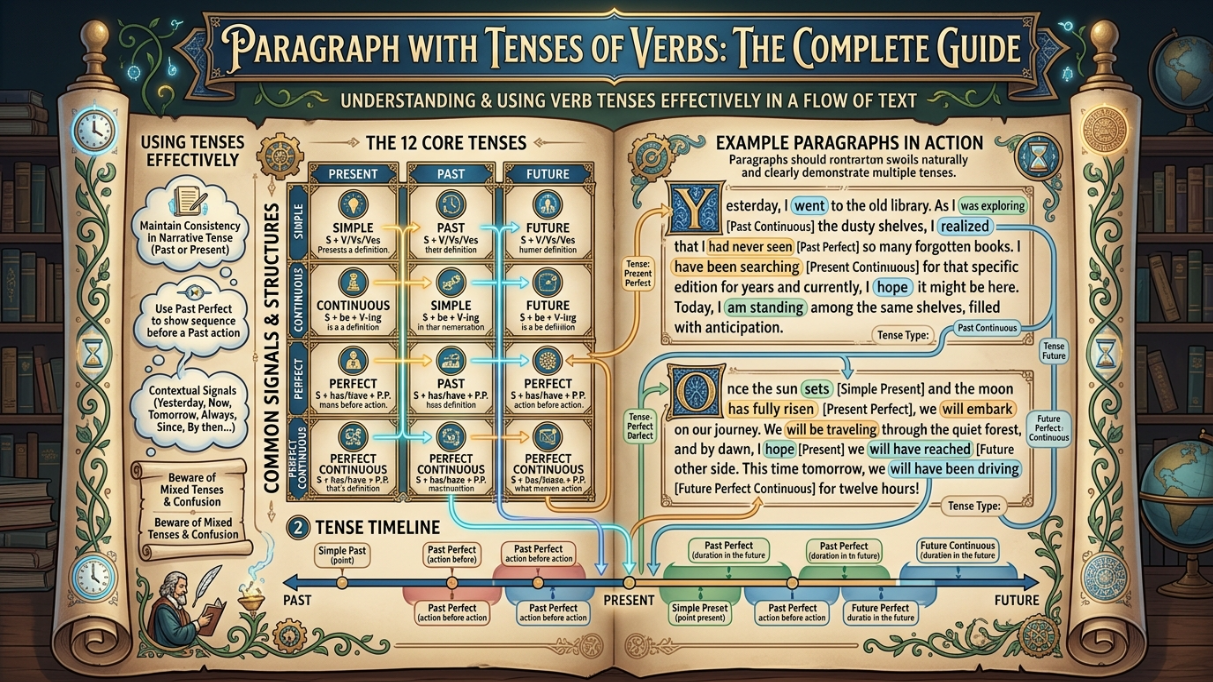

Writing a paragraph with tenses of verbs is one of the most effective ways to understand how English grammar works in real communication. Rather than memorizing isolated rules, learners see how different verb tenses function naturally within a meaningful context. This approach strengthens grammar, improves writing, and builds confidence in speaking English.
Whether you are a student, teacher, job seeker, or English learner, mastering a paragraph with tenses of verbs helps you communicate ideas clearly. This guide explains the purpose of verb tenses, demonstrates practical examples, highlights common mistakes, and provides strategies that make learning easier and more enjoyable.
Understanding the Meaning of Verb Tenses
Verb tenses show when an action happens. They indicate whether something occurred in the past, is happening now, or will happen in the future. Every sentence depends on the correct tense to express time accurately and avoid confusion.
A well-written paragraph with tenses of verbs combines different tenses naturally. Instead of switching randomly, each tense serves a specific purpose based on the sequence of events and the writer’s intended meaning.
Why Paragraph Practice Matters
Learning individual tense rules is helpful, but applying them in connected writing creates deeper understanding. Paragraph writing encourages learners to think about relationships between events instead of isolated grammar exercises.
When students regularly practice a paragraph with tenses of verbs, they improve grammar, vocabulary, sentence structure, and overall communication. This integrated approach also develops stronger reading comprehension and editing skills.
The Twelve Main English Verb Tenses
English grammar includes twelve major verb tenses, grouped into present, past, and future forms. Each group contains simple, continuous, perfect, and perfect continuous tenses, allowing speakers to express different aspects of time.
Understanding these patterns makes writing a paragraph with tenses of verbs much easier because every tense has a predictable structure and a clear purpose in communication.
Present Tenses in Context
Present tenses describe habits, facts, current actions, and situations that began in the past and continue today. They are among the most frequently used verb forms in everyday English.
A strong paragraph with tenses of verbs often begins with present simple to introduce a topic before moving into other tenses that explain background information or future plans.
Using Past Tenses Correctly
Past tenses explain completed actions, ongoing events in the past, earlier experiences, and activities that continued over time. They help readers understand sequences and causes.
For example, a student might write that she studied every evening, was preparing for exams, had completed her assignments, and had been practicing English for months before the final test.
Expressing Future Ideas
Future tenses describe predictions, plans, promises, and actions that will happen later. They help writers discuss goals, expectations, and upcoming events clearly.
Including future forms in a paragraph with tenses of verbs demonstrates a complete understanding of time relationships and creates more realistic, engaging writing.
Example Paragraph With Tenses of Verbs
Yesterday, I woke up early because I had planned an important presentation. I was reviewing my notes while my classmates were preparing their materials. By the time the teacher arrived, everyone had finished the final preparations. Today, I feel more confident because the presentation was successful. Next week, I will begin another project, and I will be applying the lessons I learned from this experience.
This sample paragraph with tenses of verbs demonstrates how multiple tenses work together naturally to create a logical and meaningful narrative.
Common Mistakes to Avoid
Many learners change tenses without a logical reason. Others confuse perfect tenses with simple tenses or forget to match verb forms with time expressions such as yesterday, now, or tomorrow.
Careful proofreading helps ensure that every paragraph with tenses of verbs follows a consistent timeline. Reading your work aloud also makes tense inconsistencies easier to identify.
Comparison of Major Verb Tenses
| Tense | Primary Purpose | Example |
|---|---|---|
| Present Simple | Habits and facts | She studies every day. |
| Present Continuous | Current actions | She is studying now. |
| Present Perfect | Past action affecting the present | She has finished her work. |
| Present Perfect Continuous | Continuing activity | She has been studying for two hours. |
| Past Simple | Completed past action | She studied yesterday. |
| Past Continuous | Ongoing past action | She was studying when I called. |
| Past Perfect | Earlier past action | She had studied before the test. |
| Past Perfect Continuous | Duration before another past event | She had been studying all week. |
| Future Simple | Future action | She will study tomorrow. |
| Future Continuous | Ongoing future activity | She will be studying tonight. |
| Future Perfect | Completed future action | She will have finished by Friday. |
| Future Perfect Continuous | Duration before a future point | She will have been studying for six months. |
Practical Tips for Better Writing
Start by deciding the main time frame of your paragraph. Once the primary timeline is clear, introduce other tenses only when necessary to explain background, ongoing actions, or future events.
Regular reading, journaling, and editing strengthen your ability to write a natural paragraph with tenses of verbs. Practice with real-life topics such as school, travel, hobbies, or work to make learning more meaningful.
Teaching and Learning Strategies
Teachers often encourage students to write short stories because stories naturally require different tenses. This method transforms grammar from a memorization exercise into practical communication.
Learners benefit by reviewing corrected writing, identifying tense patterns, and rewriting paragraphs. Over time, every paragraph with tenses of verbs becomes more accurate, fluent, and engaging.
Expert Perspective
As the linguist Stephen Krashen observed, “We acquire language when we understand messages.” This insight reminds us that grammar is most effectively learned through meaningful communication rather than isolated drills.
Writing a paragraph with tenses of verbs supports this idea by connecting grammar rules with realistic situations, making tense usage easier to understand and remember.
Conclusion
Mastering verb tenses is essential for clear and effective English communication. Understanding when and why each tense is used allows writers to express ideas accurately while creating logical, engaging paragraphs.
Consistent practice with a paragraph with tenses of verbs develops confidence, strengthens grammar, and improves both academic and professional writing. By reading regularly, writing frequently, and reviewing mistakes carefully, anyone can achieve greater fluency and precision in English.
FAQ
What is a paragraph with tenses of verbs?
A paragraph with tenses of verbs is a short piece of writing that uses one or more verb tenses correctly to describe actions across different periods of time.
Why is a paragraph with tenses of verbs important?
It helps learners understand how verb tenses work together naturally instead of learning grammar rules in isolation.
How can I improve my paragraph with tenses of verbs?
Practice writing daily, read English texts, review grammar rules, and proofread your work for tense consistency.
Which tense should beginners learn first?
Most beginners should start with the present simple tense before progressing to past, future, and perfect tenses.
Can one paragraph include multiple tenses?
Yes. A well-organized paragraph with tenses of verbs often combines present, past, and future tenses when they logically fit the timeline of the ideas being expressed.